Wednesday, May 21, 2014

Boston Festival of Bands

The Concord Band performs for the annual
Boston Festival of Bands at historic Faneuil Hall.
The Concord Band has been invited to perform at the 26th annual Boston Festival of Bands, to be held Saturday June 14 at Faneuil Hall in Boston (in the Great Hall on the 2nd floor). At this day-long event, seven of the best community concert bands from all around New England play on the hour, from 11 AM to 6 PM. The Festival is the most distinguished community concert band festival in New England. It is free and open to the public. The Concord Band will perform at 4 PM.

The Boston Festival of Bands is hosted by The Metropolitan Wind Symphony, funded in part by the Massachusetts Cultural Council, a state agency, and by the National Endowment for the Arts. The Boston Festival of Bands was founded by the Metropolitan Wind Symphony in 1989, and has included bands from all 5 New England states and Canada.

This will be the 18th time in the Festival's 26-year history that The Concord Band—winner of the Sudler Silver Scroll Award for 2013, "North America's most prestigious award for community concert bands"—has performed at the Boston Festival of Bands.

Program

  • Beyond the Horizon by Rossano Galante
  • An Original Suite by Gordon Jacob
  • Dusk by Steven Bryant
  • Symphonic Dance No. 3, "Fiesta" by Clifton Williams
  • Yellow Rose of Texas Variations, by Lou Buckley, cornet solo by the composer
  • Wings Across America by Roger Cichy

Schedule of Performances

11am
Middlesex Concert Band (Wakefield, MA)
12noon
New England Brass Band (Franklin, MA)
1pm
Metropolitan Wind Symphony (Jamaica Plain, MA)
2pm
American Band (Providence, RI)
3pm
Casco Bay Concert Band (Portland, ME)
4pm
Concord Band (Concord, MA)
5pm
Charles River Wind Ensemble (Newton, MA)

Fruitlands Museum Summer Concert Series Video

2014 Fruitlands Summer Concert Series

Thursdays at 7:15 pm
Fruitlands Museum, Harvard MA

Join us as we provide the soundtrack for your summer. Fruitlands Museum's beautiful natural amphitheater provides a perfect setting for a sunset concert, featuring breathtaking views of the Oxbow National Wildlife Refuge. Bring your entire family and a picnic as desired.

Parking $15 per vehicle, $10 for museum members.
June 19
Songs of Summer
June 26
Fruitlands Centennial Celebration
July 3
American Salute
July 10
From Broadway to Hollywood—musicals that became movies
July 17
Flying High—celebrating the anniversary of the moon landing and maiden voyages
July 24
A Summer Restrospective

Sunday, April 13, 2014

Meet the Double-Reed Section

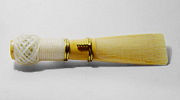
This group of woodwind instruments is
unified by the pair of reeds that create the
instruments’  sound as air is blown
between them.
THE INSTRUMENTS

The four double-reed instruments are the oboe, English horn, bassoon and contrabassoon. They have, as a group, a distinctive sound, often described as nasal.

The oboe first appeared in the mid-17th century and continued to evolve until the late 19th century, at which point the design and construction of the modern oboe were fully established.

English horn (l)
oboe (r)
While the oboe is the soprano member of the double-reed family, the English horn (or cor Anglais) is the tenor member, sounding a perfect fifth below the oboe. Its bulbous bell gives it a tone that is typically described as more mellow and plaintive than that of the oboe, closer in tonal quality to the oboe d’amore, an early member of the family. It is typically scored only when its unusual tone quality is desired.

contrabassoon (l)
bassoon (r)
The bassoon plays the role of the bass-baritone member of the double-reed family. It has been produced in its modern form since the early 19th century, but increasing demands on capabilities of instruments and players in the 19th century— particularly larger concert halls requiring greater volume—and the rise of virtuoso composer-performers spurred further refinement.

The low-pitched contrabassoon is probably scored so rarely in band music because few musicians—other than those who regularly play the contrabassoon in symphony orchestras—have access to them.