 |
| John Ferillo Guest Artist, oboe |

Showing posts with label double-reed. Show all posts
Showing posts with label double-reed. Show all posts
Thursday, September 1, 2016
John Ferrillo, BSO Principal Oboist, Named Honorary Member

Tuesday, December 15, 2015
Holiday Pops with the Concord Band
 Featuring Guest Artist John Ferrillo
Principal Oboe with the BSO

December 11 & 12, 2015
Review by Vanessa Rene
The Concord Band has proven once again that music makes the holidays brighter with their annual Holiday Pops program this past weekend. Normally, we don’t write reviews of Pops programs because, after all, they’re Pops programs, right? This one was completely different, though, through the addition of solo performances by John Ferrillo, Principal Oboist with the Boston Symphony Orchestra. His inspired performances left the audience transfixed, including this reviewer and several of her friends in the audience who are, after all, students of the oboe as well.
The Concord Band is a gem, and the Greater Boston community is very fortunate to have this group as a cornerstone of the community. They performed several well-known favorites, such as Overture to a Winter Festival by James Curnow (commissioned by the Concord Band in 1995), Chanukah is Here by Calvin Custer, Swingin’ Santa, arranged by William McManus and Auld Lang Syne, a stirring and emotional arrangement of the traditional theme by the late William Toland, founding director of the Concord Band and long-time educator in the Bedford School System. These winter favorites were played cleanly and crisply, as is to be expected of this high-caliber performing group.
A new piece, Minor Alterations by David Lovrien, consists of many old favorite Christmas melodies set in a minor mode. Conducted by Assistant Director Steve Barbas, it is a bit like “Mary Poppins” meets “The Nightmare Before Christmas,” and was thoroughly delightful.
Friday, November 20, 2015
BSO Principal Oboist John Ferrillo to Perform
 |
| John Ferrillo Principal Oboe, Boston Symphony Orchestra |
Harvard resident John Ferrillo played oboe in the Greater Boston Youth Symphony Orchestra and attended Curtis Institute. Prior to joining the BSO in 2001, Ferrillo was the principal oboe in the Metropolitan Opera Orchestra. He has taught and performed at the Aspen and Waterloo festivals and currently serves on the faculty of the New England Conservatory, Boston University, and the Boston University Tanglewood Institute.
Sunday, April 13, 2014
Meet the Double-Reed Section
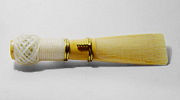 |
| This group of woodwind instruments is unified by the pair of reeds that create the instruments’ sound as air is blown between them. |
The four double-reed instruments are the oboe, English horn, bassoon and contrabassoon. They have, as a group, a distinctive sound, often described as nasal.
The oboe first appeared in the mid-17th century and continued to evolve until the late 19th century, at which point the design and construction of the modern oboe were fully established.
 |
| English horn (l) oboe (r) |
 |
| contrabassoon (l) bassoon (r) |
The low-pitched contrabassoon is probably scored so rarely in band music because few musicians—other than those who regularly play the contrabassoon in symphony orchestras—have access to them.
Subscribe to:
Posts (Atom)