Showing posts with label section. Show all posts

Thursday, January 15, 2026

Meet the Flute Section

2026 Concord Band Flute Section (l. to r.): Chris Mudgett, Elizabeth Pearson, Katie Hock, Kristen Bankuti, Roberta Nicoletta.
Not pictured: Ellen Feldman, Laura Finkelstein, Debra Franks.

The Concord Band comprises many talented and accomplished musicians. This article continues an occasional series presenting an in-depth profile of each instrumental section. In this installment we introduce the distinguished members of our flute section.

Profiles

Kristen Bankuti is originally from Sudbury and now resides in Maynard. She attended Concordia College in Moorhead MN and graduated with a degree in music performance and business administration. She received a master’s degree from Northeastern University and works as a speech and language pathologist. In addition to the Concord Band, Kris also leads a flute ensemble.

Ellen Feldman grew up in Philadelphia, where her principal flute teacher was John Krell, piccolo player in the Philadelphia Orchestra. She attended Barnard College, majoring in music history and music theory. She earned a PhD in cinema studies at New York University. Ellen moved to Cambridge and became a course developer for Prime Computer and Avid Technology. A member of the Concord Band since 1988, she also plays in a flute choir. Her interests include street photography and the French language.

Laura Finkelstein was raised outside of New York City and attended Binghamton University, earning a degree in linguistics. She served the Band for many years as a publicist, learned about history of music from records at the public library, and went on to work for WGBH, including directing live studio performances, and coordinating summer weeks from Tanglewood.

Debra Franks grew up in central Arkansas and resides in Bedford MA. Inspired by her older brother, who was a clarinetist and drum major, she joined a band in sixth grade after four years of music training on the piano. She pursued her musical passion by earning a bachelor’s degree in music education. Professionally, she is a CPA with an MBA from University of Arkansas and a master’s degree in accounting and finance from Bentley University, and heads her own accounting firm. Her lifelong dedication to the flute is supported by many years of performing and private study that continue today.

Katie Hock. Originally from Suffern NY, Katie currently lives in Worcester. She attended Nazareth College, where she played flute and piccolo in wind ensemble and symphony orchestra, and earned a bachelor’s degree in music therapy and flute performance, with a minor in music history. She then earned a master's degree in music therapy and mental health counseling from Lesley University. She works as a pediatric music therapist, where she also sings and plays piano, guitar, and ukulele.

Chris Mudgett, a resident of Bolton MA, attended Bedford High School, earned a bachelor’s in theater arts from UMass Amherst, then independently studied computer science, leading to a 35-year career as a software engineer and program manager. She has been involved with the Rotary club for five years including one year as president. She has been a member of Concord Band since the mid-70s, including serving as Board president. Her musical activities include a flute choir, singing in a cover band that performed at high school reunions, and an acoustic trio that regularly performed at Tewksbury Hospital’s Huntington’s ward.

Roberta Nicoletta was raised in Bedford MA. She studied flute with James Papoutsakis and Phillip Kaplan and earned a bachelor’s degree in music education from Boston University. Roberta taught music at elementary through high school levels in the Manchester Public Schools, as well as North Shore Community College. She moved with her husband to Cormano, Italy, for five years, where she taught English and gave private flute lessons. Returning to the States, she raised her sons in Chelmsford, worked at Concord Academy and then Concord-Carlisle HIgh School. She is also active in local music ensembles.

Elizabeth Pearson is a native of the Bay State now residing in Chelmsford. She graduated from Gordon College with degrees in psychology and music, and earned a masters degree and a Certificate of Advanced Graduate Studies from Boston University. She worked as a psychotherapist in the community, clinical director for a group of mental health clinics, and currently is in private practice.

Interviews

How did you start playing your instrument?

Kris—The first instrument I learned was the clarinet, then I switched to flute because it was easier to play duets with friends who played flute and violin—no transposing was needed.

Ellen—I heard William Kincaid play in the Philadelphia Orchestra and I was hooked! At first, I had to take two years of piano lessons. After that, I started studying the flute.

Laura—I grew up outside New York City learning some folk guitar and piano, played flute a little bit in high school, then went to school in upstate NY. I didn't purchase a professional instrument or take lessons until I moved to the Boston area.

Chris—In fourth grade our music teacher, Bill Toland, showed us various band instruments. I told my parents I wanted to play the flute. My flute lessons began with two other girls, with Bill as our teacher. He also taught band, which I joined as soon as I could play a little. By high school I had a private flute teacher. Bill Toand, who was also conductor of the Concord Band from 1962–1995, invited me to join. It was a tremendous privilege to have had him in my life for so many years, as a music teacher and later a music colleague.

Roberta—I chose playing the flute in the fifth grade in the Bedford Public Schools, because I was intrigued by its singing sound and enormous range. During high school my band director was the one and only Bill Toland, who instilled in me the inspiration to study Music Education at Boston University.

Elizabeth—I was fortunate enough to grow up in a family where music was a priority. My parents and aunt were accomplished musicians who performed extensively and supported community endeavors. It was just what we did.

What inspires you and keeps you interested in music performance?

Kris—I have performed in concert bands and small ensembles all throughout my school years and into my adult life. Although I chose a career as a speech-language pathologist, I still enjoy making music with others.

Ellen—I still love playing the flute, and especially playing music that’s very exciting, adventurous, and it might be very modern.

Laura—Everything started with The Concord Band. For some reason I always wanted to play piccolo; asked Bill Toland if he'd let me try it out; he said 'sure', to rent a piccolo from a music store. After about three months of work on my own I was pretty competent, and LOVED it!

Chris—At some gut level I just want to play music, or listen to it. Playing in front of people makes me want to improve, which inspires me to practice and perform more.  I love playing all types of music and love that the  Concord Band plays such a wide variety of music. I’m inspired by playing with other musicians and by listening to lots of music, both live and recorded.

Roberta—For me, listening to live performances of jazz, classical, R&B, wind ensemble, opera, indigenous and chamber music is inspirational and critical to my own playing. Even with our extensive home collection of LPs and CDs, nothing is more key to me than hearing musicians perform live, no matter the genre or instrument; flautists, however, are first on my list!

Elizabeth—Following graduate school, I was given the opportunity to play in a symphony orchestra as well as a regimental band. These groups fostered love for service to the community and were gateways to playing in churches, school and private functions over the years. 

Please share an anecdote about the Concord Band.

Ellen—I have made many friends in the band, among them were June and Buck Grace. When we were both serving on the board, she would often invite me for dinner before the board met in her living room. How kind they were!

Laura—Almost everyone with whom I played music I met initially from The Concord Band. In time I was invited to play with orchestras, woodwind ensembles, flute choirs, and organists. I became an orchestra librarian, went to summer music camps, learned how to write feature articles for publicity..

Chris—Two memorable concert performance mishaps turned out extremely well. We had a tuba guest soloist who started playing… and nothing happened! We all froze in place, then he calmly said to the audience “you know folks, when you push the valve down it’s supposed to come back up” as he was unscrewing a valve and reassembling it on stage. The audience laughed, we exhaled in relief and went on to play the piece without a hitch. Another time, we were playing a new composition with the composer in the audience.Somewhere in the middle we got completely off and somehow miraculously  managed to get it back together pretty quickly. The audience probably didn’t notice it. I spoke with the composer afterward and he actually gave us kudos for getting ourselves out of the mess.  I don’t know how we did it but it was really fabulous to have an experience like that.

Roberta—During a college break, Bill Toland invited me along with some Bedford High alumni to meet composer Norman Dello Joio while the Concord Band rehearsed Satiric Dances for its premiere. I was in awe of Mr Dello Joio and how gracious he was with his time while he spoke about his composition and why he became a composer. It was an indelible moment in my life. Years later I found myself performing Satiric Dances, now a famous piece of band literature, with the Concord Band.

Elizabeth—Something I love about the Band is the level of professionalism, commitment, and  camaraderie. Many of the ensemble, like me, a psychotherapist, have other skilled careers and yet remain passionate and dedicated to their craft. Most importantly, however, has been the friendships and mentorships developed during my tenure with the Band.

What motivates you going forward?

Kris—The friendships I have made with other band members and the process of working together to prepare music for upcoming concerts keeps me coming back for more every week.

Ellen—I’m looking forward to the March concert because I am a total fan of musicals!

Laura—The best part has been the camaraderie among the players!

Chris—It never gets old! I like playing all the classics as well as new pieces. I enjoy doing challenging pieces that require lots of practice as well as easier ones that come together quickly. I also love seeing younger players join the group and bring new ideas to keep the concert band world vibrant. 

Roberta—I'm excited about performing the “Movie Night” music for our March concert. I'm also really looking forward to the true challenge of playing alto flute with the MET Flute Orchestra at the Groton Hill Music Center this July—always a highlight of my summer!

Sunday, October 25, 2015

Some of the Percussionists’ Less-Often-Called-For Instruments

Almost every instrumental section of the modern western concert band includes multiple instruments: flutes and piccolos; Bb, Eb, alto and bass clarinets; alto, tenor and baritone saxophones; trumpets and cornets; tenor and bass trombones, etc. But no section of the band includes anything close to the number of distinct instruments as does the percussion section.

Many concert attendees are familiar with the most frequently-played percussion instruments: timpani (set of four or five), bass drum, pair of crash cymbals and suspended cymbal, tam-tam (gong) snare drums of various depths, various kinds and sizes of tom toms, triangle, tambourine, maracas, wood block, sleigh bells and the principal members of the “mallets” family: the xylophone, glockenspiel (bells), vibraphone and chimes.

What we want to do in this article is to make you more familiar with a few of the more important among the less-often called-for percussion “accessory” instruments. (It’s not clear why these are referred to as “accessory”, but to call them “minor” might lead to confusion.) We include here only instruments that have been fairly often called for in music played by the Concord Band. To hear how these instruments sound, visit the Internet.

Wednesday, April 15, 2015

Meet the Trumpet Section

The Instrument

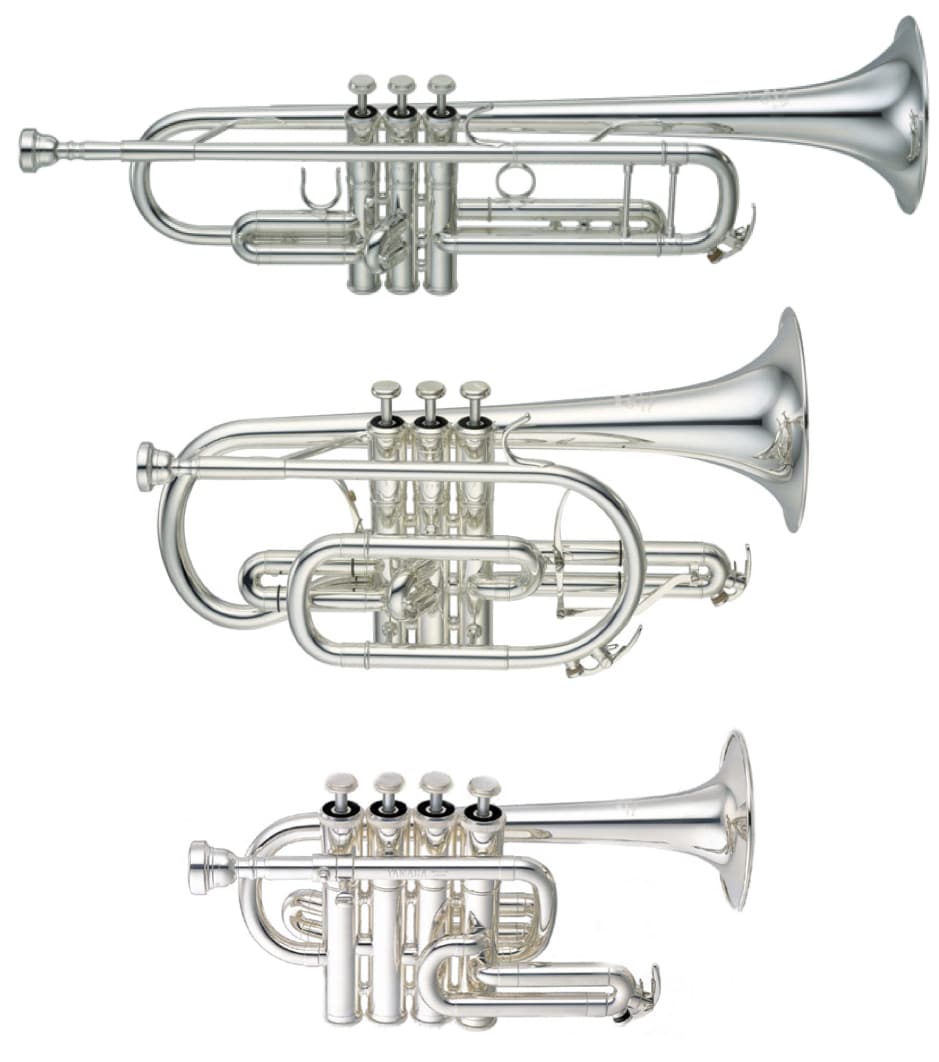
Trumpet, cornet, and piccolo trumpet (t to b)
The trumpet is one of the oldest wind instruments, dating back to 1500 BCE or earlier. The trumpet section of the Concord Band has nine members, which is fortunate since some of the compositions we play have as many as eight different parts to be played on trumpet or cornet.

The trumpet and cornet, almost always pitched in B♭ in the concert band, are the highest sounding of all of the instruments of the brass family. The two instruments, pictured in column two, have few differences. They have the same pitch range and sound almost the same.

Some would argue that their different bore shapes (the trumpet is cylindrical, like the trombone, while the cornet is conical, like the French horn), make the trumpet and cornet very different, but in a concert band trumpet section, one will often find them intermixed. A composition for band can have as many as four parts intended for trumpet and four more for cornet. These parts will not always be played on the instrument called for.

Sunday, April 13, 2014

Meet the Double-Reed Section

This group of woodwind instruments is
unified by the pair of reeds that create the
instruments’  sound as air is blown
between them.
THE INSTRUMENTS

The four double-reed instruments are the oboe, English horn, bassoon and contrabassoon. They have, as a group, a distinctive sound, often described as nasal.

The oboe first appeared in the mid-17th century and continued to evolve until the late 19th century, at which point the design and construction of the modern oboe were fully established.

English horn (l)
oboe (r)
While the oboe is the soprano member of the double-reed family, the English horn (or cor Anglais) is the tenor member, sounding a perfect fifth below the oboe. Its bulbous bell gives it a tone that is typically described as more mellow and plaintive than that of the oboe, closer in tonal quality to the oboe d’amore, an early member of the family. It is typically scored only when its unusual tone quality is desired.

contrabassoon (l)
bassoon (r)
The bassoon plays the role of the bass-baritone member of the double-reed family. It has been produced in its modern form since the early 19th century, but increasing demands on capabilities of instruments and players in the 19th century— particularly larger concert halls requiring greater volume—and the rise of virtuoso composer-performers spurred further refinement.

The low-pitched contrabassoon is probably scored so rarely in band music because few musicians—other than those who regularly play the contrabassoon in symphony orchestras—have access to them.

Friday, April 26, 2013

Meet the Trombone Section

From a rehearsal in 2002, left to right: Glenn Garvey, Mark Vincenzes, Peter Norton, David Tweed, Sam Reynolds and Andy Nichols.

The Concord Band recently presented an award to the longest-tenured member of the Band, trombonist Andy Nichols. Andy has played with the Concord Band for a full, and is retiring from the Band this season. Until we have a solo feature for Andy, here's a reprise of the article featuring the trombone section. Amazingly, ten years since this article was published in Notes from the Concord Band, at Andy's retirement the section was still 100% intact!—ed. 

When it comes to proficiency, many would agree that among all instrument sections of the Concord Band, our Trombone section ranks very high—right at the top, in your editor's opinion. What makes this so impressive is that, while players of all wind instruments must form a proper embouchure (position of the mouth—lips, tongue and teeth) to play each note, instrumentalists other than trombonists need merely depress the proper key or keys on his or her instrument to do so. Trombonists, on the other hand, must position their slides (which can travel almost two feet) to an accuracy of 1/8 of an inch! Perhaps you're not as impressed with this as is your editor (who plays only non-melodic percussion instruments, which need merely to be struck—some would say banged—at the right moment), but if you've managed to get this far, please read on.

The Concord Band's six trombonists have been with the Band an average of more than 16 years [in 2002—ed]. Four have been with the Band for fifteen years or more; a fifth, nine years. All but one were born in the Northeast (Massachusetts, New Jersey and Pennsylvania); the sixth hails from Arkansas. All began their trombone studies as children and played in school ensembles at every stage of their education. Today, four play in more than one musical group. A few play more than one instrument; one even admitted to having played the accordion!

Monday, March 4, 2013

Meet the French Horn Section

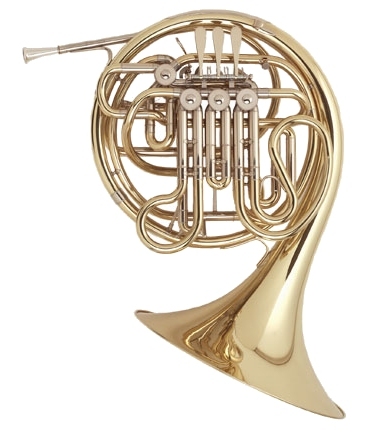
The double horn

The Intrument

Interestingly, the French horn is actually German in origin. In addition, is really two instruments in one. In 1971, it had its name officially changed to simply horn by the International Horn Society.
The horn is a brass instrument made of about 12-13 feet (3.7-4.0 meters) of tubing wrapped into a coil with a flared bell. Pitch is controlled through the adjustment of lip tension in the mouthpiece and the operation of valves by the left hand, which route the air into extra tubing.
Most horns have lever-operated rotary valves. The double horn (the most common type) has three rotary valves and a fourth valve, usually operated by the thumb, which routes the air to one set of tubing tuned to F or another tuned to Bb.

Friday, October 1, 2010

Musical Inventions Necessitated by Being a Percussionist

Plato is reported to have said “Necessity is the mother of invention” about 2,400 years ago. As far as we know, he did not have the advantage of being a percussionist. Drummers invent things all of the time simply because playing their instruments or moving quickly from one instrument to another demands it. Sometimes these inventions are commercially-available products; more often than not, one must build a device based on one’s own idea, or on a concept borrowed from a fellow percussionist.

castanet base
Percussionist Dan Diamond, who has been with the Concord Band since 1970, learned while in high school that percussionists are required to be inventive. The first stand he ever saw that allowed a player to quickly pick up and put down a pair of crash cymbals was made by Warren Myers, then principal percussionist of the Springfield Symphony Orchestra (formerly with the Boston Pops) and director of Dan’s high school band. Dan still uses a pair of castanets mounted for him by Myers on a plastic base more than 50 years ago.

wind machine
The first device that Dan was called upon to construct was in his earliest days as a member of both the Band and the Concord Orchestra, which he joined at the same time: a “wind machine”. It was called for by Bartok’s Bluebeard’s Castle, being performed by the Orchestra. Amazingly, it was needed by the Band in the very next season for Robert Russell Bennett’s Down to the Sea in Ships. A percussion wind machine produces not wind but the sound of wind. The Internet not yet having been invented, there was no way to determine easily how existing wind machines had been constructed, so Dan contacted Everett Beale, a neighbor and one of Boston’s leading free-lance professional percussionists, who described to Dan on the phone how the Boston Symphony’s wind machine was constructed.

When Neil Tischler, a consulting mechanical engineer, joined the Band percussion section in 1972, he and Dan discussed the need for a crash cymbal stand. Neil designed and built the stand that the Band still uses (photo, right). In the opinions of many percussionists, Neil’s design is more functional than the commercial products that finally became available 20 or so years ago. The principal drawback of the latter is that while several different players, located yards apart on the stage, may have to play the crash cymbals in the same piece of music, these stands do not have wheels. When the Band found it useful to acquire a commercial stand a few years ago so that one could remain at Fruitlands during the summer and one be kept at 51 Walden for rehearsals, Buck Grace, a Band percussionist since 1995, built a rolling base for the commercial stand.

While still on the subject of cymbals, but this time those referred to as “suspended,” we have two more Concord Band inventions. Neil Tischler, who plays drum set in the Band whenever it is called for, realized many years ago that it would be convenient to be able to stack two cymbals several inches apart on one stand (as long as the upper cymbal is much smaller in diameter than the lower, always the case when it is a “splash” cymbal). Being an accomplished machinist, about 20 years ago Neil fabricated an extension to the upper arm of a suspended cymbal stand by threading both ends of a steel rod: one end internally and one externally: The cymbal post extension was born.

Dan Diamond prefers to hang a suspended cymbal from a “crook” rather than to put it on the post of a suspended cymbal stand. This requires that a leather cymbal strap—similar to the kind used for crash cymbals—be attached to the cymbal. The problem with this is that it takes a few minutes to untie and retie the special knot that holds a cymbal strap to a cymbal, meaning that it becomes inconvenient to quickly switch a suspended cymbal from “crook” use to “stand post” use. So Diamond invented a quick-change strap that goes on and comes off in seconds.

Dan Diamond is the senior member of the Concord Band, having joined the ensemble in January, 1970. He is a percussionist who began his lifelong love affair with the snare drum 63 years ago. His is also the founder/ editor of our newsletter, Notes from the Concord Band.

Sunday, November 1, 2009

Meet the Concord Band Percussion Section

138 Years of Combined Service...and Counting

The Concord Band percussion section— and the percussion sections of large instrumental ensembles of all kinds—may be described in terms of extremes. At one time or another, percussionists are responsible for gathering hundreds of different combinations of pitched and unpitched instruments and beaters. As most drummers will tell you, the most difficult problem they usually face is not in playing their parts, but in setting up and moving between their instruments as quickly as necessary when the section has a limited number of players.
(l to r): Dan Diamond (snare drum), Ken Troup (mallets),
Neil Tischler (drum set, tympani), Buck Grace (bass drum, cymbals),
Steve Polit (tympani, mallets).


The Concord Band’s five percussionists, with tenures of 39, 38, 37, 14 and 10 years, rank 3rd, 4th and 5th longest among all active Band members. They are very well educated—with two doctorates and a handful of other advanced degrees among them. Though they may wish it were otherwise, they are also probably the oldest section of the Band.

Monday, October 1, 2007

Meet the Clarinet Section

The clarinet family:
Contrabass (BB♭), Bass (B♭), Alto (E♭), B♭, E♭

The Instruments

The origins of the modern clarinet, according to the Instrument Encyclopedia, can be traced back to the 14th century. By the late 17th century, this single-reed instrument was an established component of ensembles of many kinds. The clarinet reed, like that of the saxophone, is referred to as a "beating" reed that vibrates against the instrument's mouthpiece, as is distinguished from the double or "free" reed employed on the oboe and bassoon.

The clarinet continued to evolve until the late 1840s, when it was revolutionized through the application of a fingering system that had originally been developed by Theobald Boehm for the modern flute. The Boehm system made the clarinet easier to play, improved its tone quality and expanded the range of each member of the clarinet family (see graphic). Today's set of clarinets, as used in symphonic wind ensembles such as the Concord Band, consists of the five instruments shown, and a few others (e.g., instruments in A and C), more commonly called for in orchestral music, the ranges of which extend above and below that of the most common B♭ clarinet. Before the introduction of the Boehm system, frequent changing of instruments was often a necessity during the course of performing a single piece.

Of the five instruments shown in the graphic at the right, the upper (smaller) four are used in virtually every piece the Concord Band plays. The Band owns a contrabass instrument for those situations in which it is required. The B♭ instrument is without doubt the workhorse of the family. The Band's instrumentation usually consists of one E♭, one alto, two or three basses and as many as 15 B♭ clarinets. Clearly the clarinet section is the most populous in the Concord Band, representing nearly one third of our players.

The success of the clarinet as an instrument is attributable to several factors: the ability of its sound to blend well with that of every other instrument and its flexibility and comfortable fit with every kind of music from folk and jazz to concert music that ranges in time from the pre-Baroque to the most arcane of contemporary works.
The Concord Band clarinet section, gathered at a rehearsal for one of the Band's concerts during the summer of 2007. Left to right, front row: David Purinton, Yvonne Dailey, Claire Napoleon, Karen Whitehead, Adena Schutzberg, Len Schatz and Bob Tyler. Second row: Paul DeWolfe, Paul Silver, Judy Piermarini, Charlie Learoyd, Jeff Leiserson and Elliot Finkelstein. Not present for photo: Lorraine Chase, Gina DePaoli, Anne Kandra, Alvin Lipsky, Linda Menkis, Louis Sinoff and Ann Wirtanen.

Thursday, September 1, 2005

Meet the Saxophone Section

At a recent concert, the Concord Band's saxophone section, left to right: Jerry Kriedberg (alto),
Gwenn O'Keeffe (alto), Judy Piermarini (tenor), Dave Southard (tenor) and Larry Rubin (baritone).

According to the Instrument Encyclopedia, the saxophone is a relatively young instrument, having been invented by Belgian manufacturer, Adolphe Sax, and exhibited to the world for the first time at the 1841 Brussels Exhibition. It is classified along with the clarinet as a single-reed woodwind, but is actually a hybrid, borrowing elements from both the clarinet and double-reed oboe. The saxophone was originally available in fourteen different sizes and keys. Currently, four sizes and keys of saxophone have been standardized — the soprano (B♭), the alto (E♭), the tenor (B♭), and the baritone (E♭) — see insert below.